
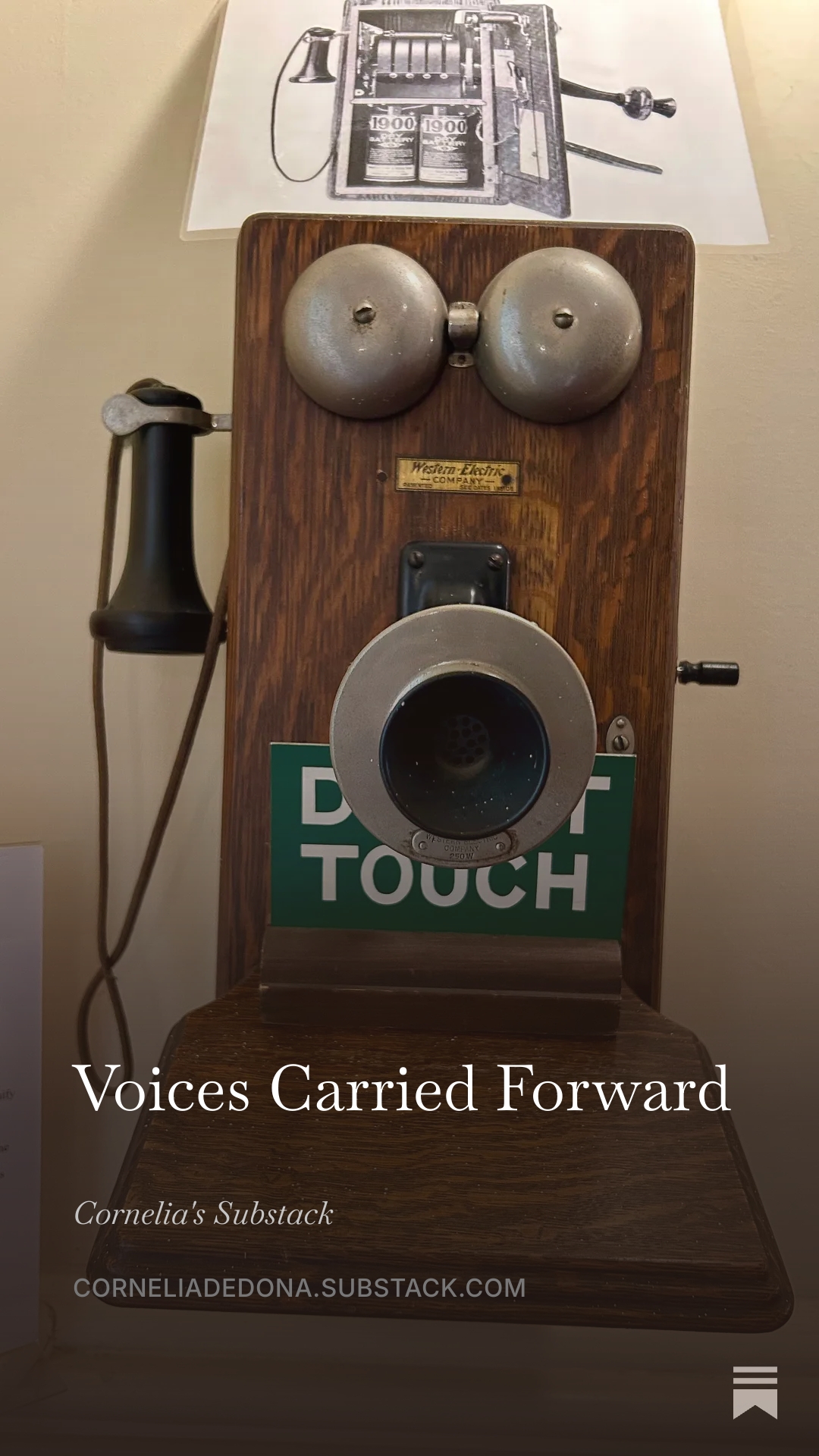
On September’s first light in 1878,
when morning wires began to sing,
voices traveled over copper strands
and distance learned a different thing.
The boys who once had mocked the calls
fell silent at the sound—
for patience, skill, and steady hands
were changing what was possible, what could be found.
Emma Nutt, the first woman
to answer the telephone’s call,
sat among the tangled cords
where laughter once had filled the hall.
No cannon marked her entrance.
No trumpet called her name.
Just nimble hands, a listening ear—
and nothing stayed the same.
With every connection calmly made,
with every voice put through,
she helped a new world find its way
from one unheard voice to two.
Yet long before those ringing lines
had learned to cross the air,
in 1773, Phillis Wheatley
lifted words from silence there.
A young Black woman, carried far
from the country of her birth,
she answered those who doubted her
with verses of uncommon worth.
They questioned whether she could think,
whether her voice could be believed;
she answered not with anger alone,
but with the words she had conceived.
Her poems became a lantern
for minds that would not see:
a voice they thought could not be heard
spoke with its own authority.
Then came the years of marching feet,
of banners, grief, and flame—
of women who refused to wait
for justice to remember their name.
They walked through years of sacrifice,
they pressed against the door,
until the law that barred the vote
could bar them there no more.
The Nineteenth Amendment rose
in nineteen-twenty’s light—
a hard-won sign that women’s voices
could enter public life.
The ballot box opened new ground;
new possibilities could start.
Yet freedom, written into law,
still left too many standing apart.
And Shirley Chisholm stepped forward—
elected to Congress in 1968—
then sought the presidency in 1972,
refusing to accept a smaller place.
With unmistakable courage,
she kept asking, clear and bright:
Whose voice is heard?
Whose voice counts?
Who has a claim to civic light?
She carried hope into the struggle,
made courage into sight,
and turned a woman’s voice and vote
into a claim to equal right.
Now Wheatley’s ink and Nutt’s switchboard,
the marching feet, the votes—
their stories form a living thread
that history still holds.
Not every victory thundered.
Not every triumph shone.
Some changed the world by writing words;
some simply held their ground alone.
But every woman who stepped forward,
who answered, wrote, or fought,
left one more door ajar
to one more once-impossible thought.
One voice became another.
One hand reached for the next.
One generation carried forward
what the last had dared to protect.
So let September’s morning come
with memory in its breeze—
with echoes of the women
who made pathways where none had been.
For history is not a monument
of marble, stone, and steel.
It is every voice that dared to rise,
every wound that refused to heal,
every hand that opened what was closed,
every dream that would not die,
every woman who stood and said,
“I belong. I will not be denied.”
The wires still hum.
The pages turn.
The ballots wait for hands.
The torches still burn.
And somewhere, even now,
a voice is gathering strength—
finding courage in the voices
that carried hers this far.
The chain endures:
from Wheatley’s pen
to Nutt’s patient hands,
from marching feet
to ballots cast,
from one brave voice
to another—
across the years,
across the distance,
across every barrier raised,
a living song
of courage,
dignity,
and voices carried forward.
Leave a Reply